

Five years after Myanmar’s military seized power in a coup, the Association of Southeast Asian Nations’ signature response to the crisis — the Five-Point Consensus — remains officially intact. Regional leaders continue to invoke it. Diplomatic statements continue to reference it. The framework remains ASEAN’s stated roadmap for resolving Myanmar’s turmoil.
But a growing gap has emerged between ASEAN’s rhetoric and its actions.
Recent signs of renewed engagement with Myanmar’s military authorities suggest that, while ASEAN has not formally abandoned the Five-Point Consensus, it may be quietly moving beyond it in practice. Faced with the failure of its flagship initiative and the persistence of conflict, ASEAN appears increasingly focused not on resolving Myanmar’s crisis but on managing its consequences.
This shift matters because it reveals both the limits of ASEAN’s influence and the changing realities of Myanmar’s conflict.
When ASEAN leaders unveiled the Five-Point Consensus in April 2021, the initiative was presented as a pathway out of the crisis. The framework called for an immediate cessation of violence, dialogue among all parties, mediation by a special ASEAN envoy, humanitarian assistance, and envoy access to all stakeholders.
At the time, many regional governments appeared to believe that Myanmar’s crisis could be contained through diplomatic pressure and regional engagement. The military was expected either to compromise or eventually recognize the costs of isolation. Neither happened.
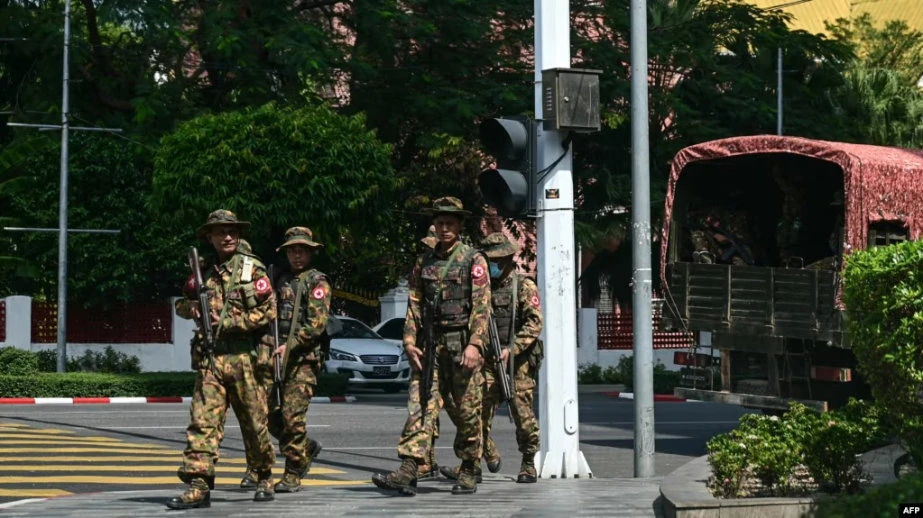
Instead, the conflict expanded dramatically. Resistance movements emerged across the country. Ethnic armed organizations intensified military operations. The junta responded with escalating force. Myanmar descended into a nationwide conflict far more severe than many regional policymakers had anticipated.
The Five-Point Consensus failed to achieve any of its core objectives. Violence did not decrease. Political dialogue never materialized. ASEAN envoys struggled to gain meaningful access. Humanitarian assistance became entangled in political disputes. Most importantly, the military leadership demonstrated little willingness to comply with the framework and faced no real consequences for ignoring it.
The fundamental problem was never simply implementation. It was structure.
ASEAN’s influence depends largely on persuasion, consensus and diplomacy. It possesses few enforcement mechanisms. Unlike the EU, it cannot impose meaningful collective penalties. Unlike major powers, it lacks the economic or military leverage to compel compliance. The Five-Point Consensus ultimately relied on the assumption that Myanmar’s military valued ASEAN’s approval sufficiently to change its behavior. That assumption proved incorrect.
As the conflict deepened, another challenge emerged: ASEAN itself was never fully united on Myanmar.
ASEAN appears increasingly focused not on resolving Myanmar’s crisis but on managing its consequences.
Dr. Azeem Ibrahim
Some member states viewed the crisis primarily through the lens of democratic legitimacy and political reform. Others prioritized regional stability. Several remained committed to ASEAN’s long-standing principle of noninterference in domestic affairs. Different governments also held varying assessments of the risks posed by Chinese influence, refugee flows, transnational crime and economic disruption.
The Five-Point Consensus temporarily papered over these differences by creating a common diplomatic position. But as the initiative stalled, underlying divisions inevitably resurfaced. This helps explain why recent developments are so significant.
Rather than intensifying pressure on the junta, ASEAN increasingly appears to be adapting to realities on the ground. Reports of renewed engagement with Myanmar’s military authorities suggest a growing recognition that isolation alone has failed to produce results.
This does not necessarily reflect support for the junta. Nor does it indicate approval of the military’s actions. Rather, it reflects a broader shift in priorities.
Five years ago, ASEAN’s objective was conflict resolution. Today, its priority increasingly appears to be conflict management. The distinction is important.
Conflict resolution seeks political transformation. It aims to end violence, reconcile competing actors and create a sustainable settlement. Conflict management accepts that such outcomes may not be achievable in the near term. Instead, it focuses on limiting regional spillover, reducing instability and preventing further deterioration. Increasingly, ASEAN’s actions suggest the latter approach.
Regional governments are becoming more concerned about the practical consequences of Myanmar’s instability than about achieving an elusive political breakthrough. Cross-border crime networks have expanded dramatically. Human trafficking and cyber-scam operations now affect multiple ASEAN member states. Refugee flows continue to create humanitarian and political pressures. Economic disruption affects border communities and regional trade networks.
From this perspective, engagement with Myanmar becomes less about political legitimacy and more about managing risks. This evolution may be understandable. It may even be necessary. But it has significant implications.
First, it represents a tacit acknowledgment that the Five-Point Consensus has failed to produce meaningful change. While ASEAN is unlikely to formally abandon the framework, its growing emphasis on practical cooperation suggests diminishing confidence in its original objectives.
Second, it raises questions about ASEAN’s credibility as a regional security actor. The Myanmar crisis was arguably the most significant test of ASEAN diplomacy in decades. The organization’s inability to influence events inside one of its own member states has exposed the limits of consensus-based regionalism when confronted by determined authoritarian resistance.
Finally, it reflects a broader reality about Myanmar itself.
Many of ASEAN’s original assumptions were based on the belief that Myanmar’s crisis was temporary. Five years later, it increasingly resembles a protracted conflict with no clear end in sight. Large parts of the country remain outside meaningful central control. The military continues to face resistance across multiple fronts. Political reconciliation appears more distant than ever.
Under these circumstances, ASEAN may have concluded that managing instability is more realistic than resolving it.
The Five-Point Consensus remains ASEAN’s official policy. Regional leaders will continue to endorse it publicly because abandoning it outright would amount to admitting failure. But policy is often revealed more clearly through actions than statements.
Those actions increasingly suggest that ASEAN is preparing for a future in which Myanmar’s conflict persists indefinitely. The goal is no longer transforming Myanmar’s political trajectory. It is containing the consequences.
If that is indeed the case, then the Five-Point Consensus may survive on paper while quietly losing relevance in practice. And that may be the clearest sign yet that ASEAN’s Myanmar strategy has entered a new phase.
• Dr. Azeem Ibrahim is the director of special initiatives at the New Lines Institute for Strategy and Policy in Washington.
X: @AzeemIbrahim


