
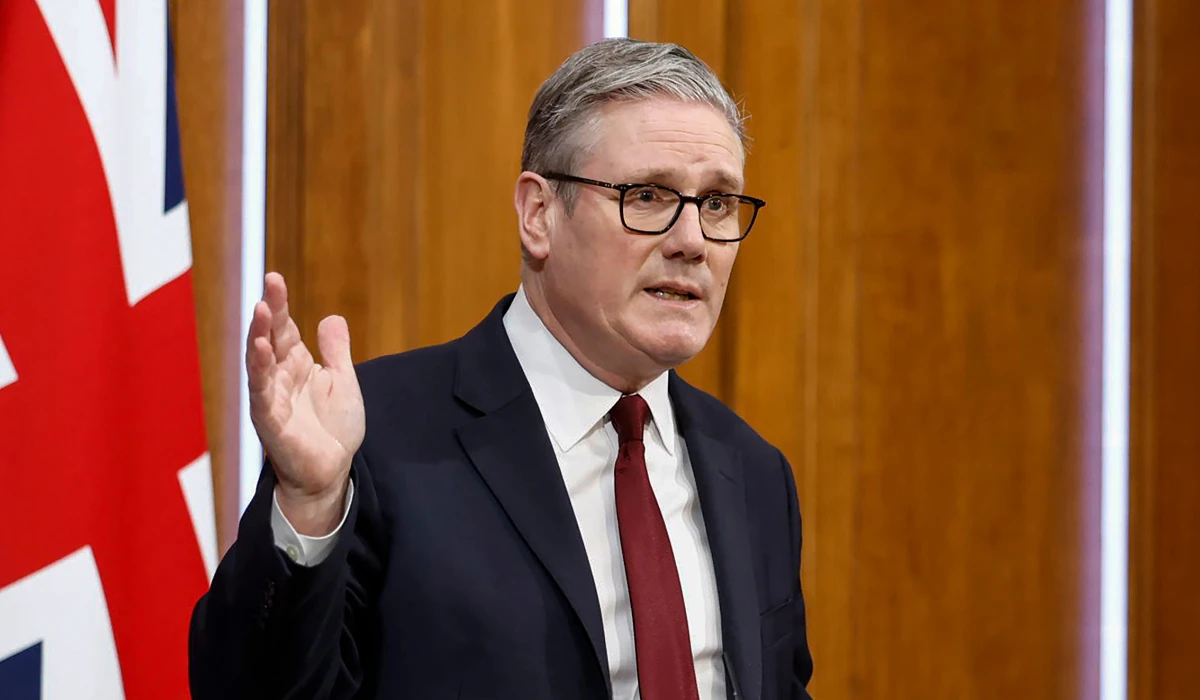

Less than two years after leading the Labour Party to a famous general election victory, a triumph that seemed to place him in the pantheon of Labour leaders and render him almost untouchable, Sir Keir Starmer this week found himself facing one of the loneliest moments any British prime minister can experience: standing in front of the distinctive black door of 10 Downing Street and announcing his resignation.
In those few moments last Monday, Starmer cut the figure of a character from a Shakespearean tragedy. He maintained his decency and dignity but could not entirely conceal the emotions and pain he was experiencing. Had the British public seen more of this side to him, perhaps, they might have been willing to give him more time to lead the country.
Politics, however, can be cruel. His likely successor, Andy Burnham, was already making the train journey from Manchester to London to be sworn in as the new MP for Makerfield as Starmer delivered his resignation speech.
Although the Burnham campaign to unseat Starmer had been slow(ish)-burning, the decisiveness of his by-election victory with 55 percent of the vote just four days earlier, particularly against the Reform candidate, had effectively sealed both men’s fate; one was almost certainly about to end his time as prime minister, while the other appeared to be heading for a coronation.
Burnham and Starmer are contrasting political figures. The former’s advantage is immediately apparent: He appears more comfortable in his own skin, more at ease in public, and is a considerably stronger communicator. Assuming he is indeed the heir apparent, and likely to face little or no opposition, he will have to hit the ground running, though.
Burnham brings with him ministerial experience from the Blair-Brown years, and is still only in his mid-50s. However, the past decade of his career has been spent in local politics, as the mayor of Greater Manchester. That role has undoubtedly given him valuable experience in dealing with the everyday concerns of ordinary people, while also allowing him to have far greater direct contact with them. It is a privilege Starmer never had and never seemed entirely comfortable with.
The mystery of Starmer’s spectacular downfall will no doubt be dissected for years to come. He rebuilt Labour from the brink of political and financial collapse in 2019 following one of its worst general election defeats. Then five years later he delivered one of the most impressive electoral victories in modern British history, securing a commanding parliamentary majority. Such a triumph should have bought him enough political capital to last at least until the next general election.
The mystery of Starmer’s spectacular downfall will no doubt be dissected for years to come.
Yossi Mekelberg
Yet his collapse was remarkably swift. It might simply be that his instinct for caution and incrementalism became his greatest weakness. Too often he appeared to arrive at the right decision only after first making the wrong one.
His rapid decline is also a reflection of wider societal trends and the intractable challenges facing modern democracies. We live in an age that demands immediate solutions but struggles to produce great ideas or long-term vision. Technology promises instant answers but, equally, undermines society, while patience and resilience are increasingly in short supply.
Starmer leaves office with achievements to his name. Progress was made on key issues, including reductions in National Health Service waiting lists, lower migration figures, falling unemployment, and modest economic growth. His record in foreign affairs also deserves recognition, at least in some areas.
That is not to say that some of the criticism leveled at him was undeserved. Nevertheless, he often appeared to receive harsher treatment from both the public and sections of his own party than his record justified.
It might not be entirely outlandish to suggest that someone whisper in Burnham’s ear that retaining Starmer as his foreign secretary would be worth considering. The incoming Cabinet, including the man expected to be prime minister, is relatively short on international experience. Starmer has accumulated considerable credibility and expertise on the world stage, and would help ensure continuity, at least in terms of Britain’s foreign affairs.
As the outgoing prime minister said during his resignation speech, service to the country comes first. Remaining in government as foreign secretary would be a natural continuation of that service for him.
From Burnham’s perspective, Starmer is hardly likely to spend his time plotting against his successor from within the Cabinet. Perhaps, as two mature politicians, they might at least entertain the possibility of working together.
For Burnham, the challenge now is to live up to the expectations he has created. He will inevitably face accusations that he lacks a direct mandate to lead the country, having not contested the 2024 general election.
There is nothing unconstitutional about his ascent to the premiership; several prime ministers from both major parties took office in similar circumstances. Yet the burden on Burnham is unusually heavy. He will be expected to deliver results immediately, while remaining faithful to an election manifesto he neither wrote nor campaigned on.
His challenge is twofold. Firstly, he must find a way to introduce an ideological outlook that probably sits somewhat to the left of the framework of the existing manifesto, but which will not be regarded as breaking any election promises.
Secondly, he must assemble the right Cabinet team to implement it. Achieving this will require far more than minor adjustments across government departments. Moreover, a prime minister’s ability to deliver is shaped now as much by events in the Strait of Hormuz, Moscow, and Kyiv as by developments in Westminster.
All of this unfolds against the backdrop of a populist wave that is spreading rapidly across social media platforms. The fact that Britain has replaced seven prime ministers in 10 years, and five in the past four years alone, is not a historical accident; it reflects a deep political and social crisis. This crisis is structural in nature and raises questions about the long-term cohesion of the Union itself.
Youth and long-term unemployment, the cost-of-living crisis, overstretched health and education systems, a generation unable to access affordable housing, the need for much closer relations with Europe, and the challenge of climate change can no longer be addressed through marginal adjustments. They require fundamental, root-and-branch reforms.
Ideas about devolving greater powers to the regions, giving people more control over their own destinies, are already emerging from the Burnham camp. Yet the real task is to stop misleading the public into believing there are easy or cheap solutions. There are none.
Reforming a welfare-liberal democracy is expensive, difficult and time-consuming. It requires patience, honesty and political courage, and it must begin now. Tough collective choices lie ahead and the new prime minister will have to lead the country through them.
In attempting to do so, Burnham would do well to remember the words of Tony Blair, one of Britain’s most experienced former prime ministers: “You start at your most popular and least capable, and you end at your least popular and most capable.”
The message is simple: Do not waste the time or political capital you have, because both of these resources are finite and short-lived.
• Yossi Mekelberg is a professor of international relations and an associate fellow of the MENA Program at Chatham House.
X: @YMekelberg


