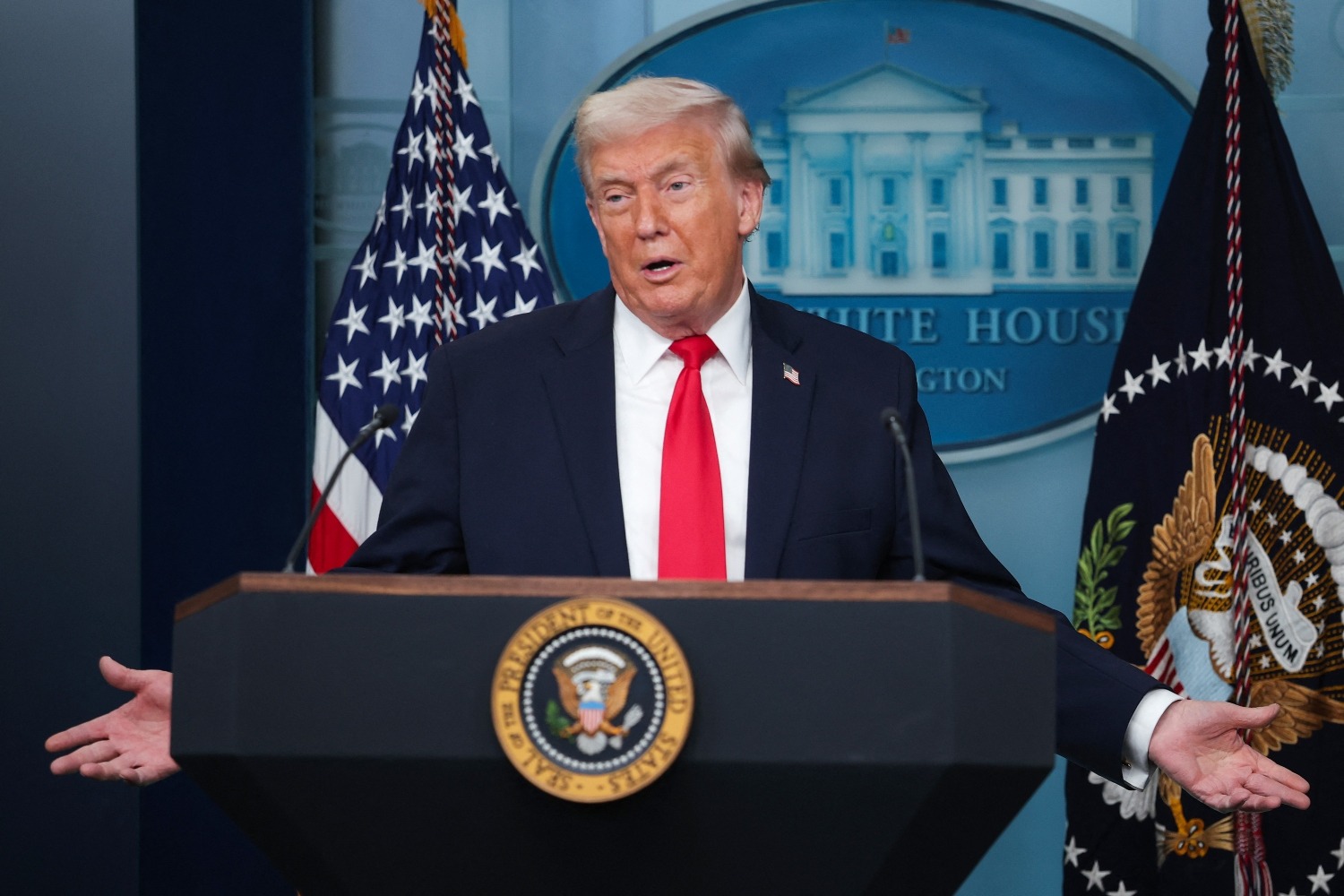

US President Donald Trump has previously threatened both military action and trade tariffs on much of Europe as he tries to acquire Greenland. The irony is that there is significant scope for a deal to be done that secures US interests, should America’s approach be based on skillful diplomacy that focuses on both security and commerce.
The public debate tends to focus on two main options: that of US military action or the potentially expensive purchase of Greenland. However, there are other pathways, such as an agreement along the lines of the Compacts of Free Association, which the US has with three Pacific island nations.
Denmark, an EU member state and NATO member, has controlled Greenland for about 300 years. In 1916, the US formally recognized Copenhagen’s interests in the island in exchange for the Danish West Indies, which became the US Virgin Islands. In recent decades, the autonomous territory that Greenland has become, with a population of about 57,000, has gone from direct Danish rule to much greater independence. Today, Denmark retains the powers of defense and foreign policy, monetary policy and justice.
Washington could push forward with diplomacy in other ways to boost its influence in and around the island
Andrew Hammond
The leaders of all five political parties in Greenland’s parliament this month said in a joint statement that “we do not want to be Americans, we do not want to be Danes, we want to be Greenlanders.” While this may preclude any future US purchase of Greenland, Washington could push forward with diplomacy in other ways to boost its influence in and around the island.
On the security front, the US first opened Thule Air Base (now known as the Pituffik Space Base) to house military assets in the 1940s. During the height of the Cold War, some 10,000 US troops were stationed on the island. The US has options to increase its military presence again very significantly, as long as it consults Denmark and Greenland. This could help to deliver key goals of America’s new security strategy, released in November, which puts greater emphasis on securing its interests in the Western Hemisphere.
This is what NATO Secretary-General Mark Rutte, a former Dutch prime minister, emphasized to Trump at the World Economic Forum in Davos last week. A growing number of European leaders, including Rutte, recognize the need for a bigger collective effort to work with the Trump team to try to make the Arctic (not only Greenland) safer for Western interests.
For instance, numerous European countries, including the UK and Germany, are debating sending more military assets to Greenland and the wider region, including ships and aircraft, as Denmark is doing. This is not incompatible with allowing the US to also expand its military base there or build new ones.
Like Europe is already doing, the US could deepen its commercial interests with Greenland in relation to its natural resources
Andrew Hammond
Beyond security and Trump’s cited concerns about China and Russia, what is often missing from his recent professions of interest in Greenland is its resource richness. As think tanks like the Center for Strategic and International Studies in Washington have shown, a defining feature of Trump’s second presidency so far has been significant US efforts to secure greater access to critical minerals and other resources across the world.
Greenland, which is currently about 80 percent ice-capped, is about 2.1 million sq. km in size. It boasts the world’s northernmost point of land — the closest land to the North Pole — just off its coast.
The growing economic focus on the Arctic stems, in large part, from the region’s melting ice caps, which are opening up new shipping lanes. These have significantly decreased maritime trade transport times, allowing ships to bypass the Suez and Panama canals.
The melting ice caps are also exposing unclaimed lands. This has been described as a modern-day gold rush, with states competing over resources including zinc, copper, iron ore and rare earth elements.
Like Europe is already doing, the US could deepen its commercial interests with Greenland in these areas. For instance, the UK last year secured a critical minerals deal with Greenland. Europe tends to lack access to both mines and the means to process raw materials, while it is also seeking to reduce its reliance on China, which dominates the production of rare earths and other critical minerals.
In 2024, European Commission President Ursula von der Leyen opened the EU’s first office in Greenland and signed a memorandum of understanding establishing a strategic partnership to develop sustainable raw materials. More than two-thirds (25 of 34) of the critical raw materials identified by the European Commission as strategically important for the bloc’s green transition are located in or around Greenland.
This twin track of diplomacy — covering both security and commerce — would be the most productive pathway for the US to deepen its interests in Greenland. Options could be developed as part of the new US-Greenland-Denmark working group that was established this month.
Taken together, the scope for a deal that secures the US greater influence in Greenland, short of an outright purchase, is significantly greater than sometimes estimated. Skillful diplomacy, not threats of military action or tariffs, would be the best way to secure this.
- Andrew Hammond is an associate at LSE IDEAS at the London School of Economics.