
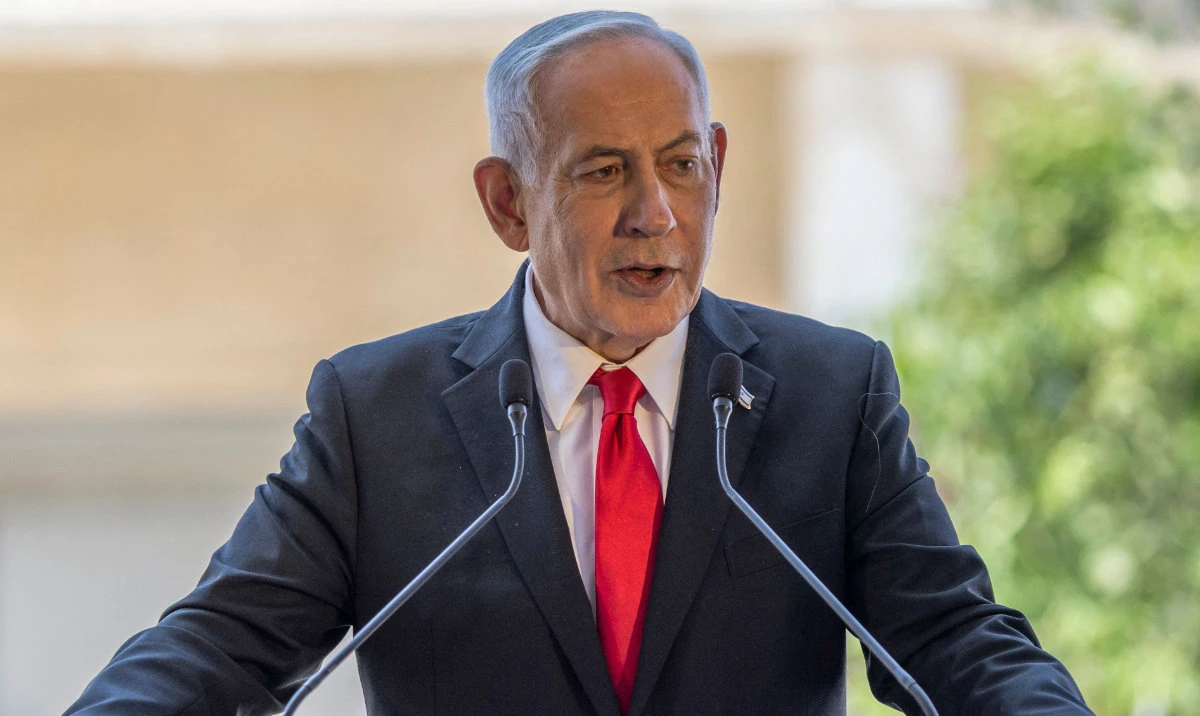

If anyone can read the writing on the wall, as reflected in the opinion polls, it is Israeli Prime Minister Benjamin Netanyahu. By now, he must have internalized that his chances of winning the next election or, more importantly, best positioning himself to form and lead the next government, are rather slim.
Netanyahu has long been an avid consumer of opinion polling. He was among the first Israeli politicians to employ foreign campaign consultants to help engineer electoral victories and, for many years, he did so with considerable success. But Israel’s political system is determined not only by how many seats the largest party wins, but by whether it can assemble a coalition commanding the required 61 of the Knesset’s 120 seats.
Current polls suggest that Netanyahu’s coalition will win no more than 51 seats, 17 fewer than it currently holds. The predominantly Jewish opposition parties are projected to secure about 58 or 59 seats, while the parties that primarily represent the Palestinian citizens of Israel are expected to win about 10. If these projections prove accurate, Netanyahu’s chances of forming a coalition government will be slim. His objective will then shift from forming a government himself to preventing anyone else from doing so.
As a result, preserving his existing coalition and keeping potential future partners within his orbit has become his overriding political priority. This is no easy task, even for a politician who has repeatedly demonstrated exceptional political skill, manipulation, unscrupulousness and ruthlessness in acquiring and retaining power.
The cohesion of his bloc — which includes the two ultra-Orthodox parties, Shas and United Torah Judaism, alongside the ultranationalist Religious Zionism and Otzma Yehudit — has become more significant than maximizing Likud’s own electoral strength. One wonders how members of his own party would respond to this.
Although an election date has yet to be formally announced, the latest it can legally be held is Oct. 27, meaning that Israel’s political system has already entered the season of election fever.
Netanyahu’s campaign rests on a three-pronged approach. First, he and his coalition partners are attempting to rewrite recent history. Or, less politely put, are simply lying about much of what has transpired over the past four years.
Second, they are seeking to prolong the atmosphere of military and national emergency. Their calculation is that security fears continue to play to Netanyahu’s long-cultivated image as “Mr. Security.” The strategy is straightforward: maintain a constant sense of threat while presenting Netanyahu as the indispensable leader, despite the fact the catastrophic failure to prevent Hamas’ deadly attack on Oct. 7, 2023, occurred on his watch and despite Israel’s continued entanglement in multiple ongoing conflicts.
Third, Netanyahu is working to placate his coalition partners by actively supporting legislation that is sectarian in nature, weakens Israel’s democratic institutions and, in some cases, knowingly undermines the country’s own security interests.
Current polls suggest that Netanyahu’s coalition will win no more than 51 seats, 17 fewer than it currently holds.
Yossi Mekelberg
His coalition partners understand better than anyone that Netanyahu is now politically weaker than at any point in his long — too long — political career. They originally agreed to form a government with him despite his ongoing indictment on three corruption charges, an arrangement that was morally reprehensible and damaging to good governance. In return, they secured extraordinary leverage over him. Since Oct. 7, their ability to extract political concessions has become virtually unlimited, essentially blackmailing at every step.
For the ultra-Orthodox parties, preventing the conscription of Haredi youth into the military remains an article of faith, driven by both ideological zeal and electoral self-interest. This comes at a time when thousands of reservists have served hundreds of days since the war began, while many soldiers have been killed or badly wounded, physically and mentally.
The latest initiative to maintain this situation is a proposed Basic Law with constitutional status that would declare Torah study a foundational value of the state of Israel. Its principal purpose is to shield draft evaders from legal sanctions. Another proposal would split the current role of attorney general and thus separate the office of the government’s chief legal adviser from that of the head of the prosecution system. The objective is equally clear: to hand politicians greater influence over the legal system while weakening its ability to oversee the executive branch.
The legislative agenda does not end there. Additional proposals seek to increase political influence over the media by facilitating the purchase of media outlets by friendly wealthy businessmen and to politicize any future commission of inquiry into the failures surrounding Oct. 7.
Keeping the pro-settlement parties satisfied has also become a central objective. More settlements in the West Bank continue to be approved, existing ones expanded and previously illegal outposts retrospectively legalized. Alongside this, the government is advancing legislation designed to increase pressure on Palestinians to sell land to settlers or to facilitate easier state confiscation of land.
These measures come with a price tag of hundreds of millions of dollars, at a time when communities in northern Israel, for instance — devastated economically by years of conflict with Hezbollah — remain in urgent need of government assistance. Moreover, in times of need, and by this I mean Netanyahu’s need to stay in power, stopping settler terrorism or prosecuting them when they do commit these acts is almost out of the question: after all, who would want to upset Itamar Ben-Gvir, Bezalel Smotrich and company if they are your political lifeline or get-out-of-jail card?
In an apparent act of political desperation, Netanyahu has once again revived his familiar promise of establishing a “broad national government” after the election. This serves as his fallback option should his current bloc fail to secure a parliamentary majority. The suggestion carries considerable irony. As arguably the most divisive politician in Israel’s history, Netanyahu is unlikely to persuade opposition leaders, many of whom no longer believe either his promises or his assurances, to go with him down that road.
His departure from politics would not, by itself, solve Israel’s many challenges. It would, however, remove the political bottleneck that he is: one that has paralyzed the country’s ability to begin addressing its challenges. Had Netanyahu devoted as much talent to governing as he has to campaigning and political survival, both Israel and his own legacy might today be in far stronger shape. Instead, that legacy lies in tatters.
As another election campaign begins, preserving his hold on power and potentially influencing the outcome of his corruption trial remain Netanyahu’s overriding objectives. If that means condemning Israel to yet another cycle of political deadlock and inconclusive elections, it seems to be a price he is prepared to pay — but it is one that the rest of the country should certainly not.
• Yossi Mekelberg is a professor of international relations and an associate fellow of the MENA Program at Chatham House.
X: @YMekelberg


