As 2025 gave way to 2026, many people across diverse societies and traditions in the Middle East and North Africa region and the wider Arab world welcomed the new year.
It is important to keep in mind that the transition into 2026 unfolded against a complex historical and political backdrop. The outgoing year was marked by significant events in various countries, including armed conflicts, humanitarian crises and economic pressures that affected many people across the region.
In spite of these challenges, the arrival of the new year once again brought many people together as a cultural expression, in hope of a more peaceful future and the reaffirmation of social bonds that have existed for thousands of years.
The celebration of the new year in the MENA region should not be viewed as a uniform or monolithic phenomenon. Instead, the festivities point to the region’s intriguing and remarkable cultural, religious and ethnic diversity.
While the Gregorian calendar’s new year does not hold universal religious significance, it has increasingly become a social and cultural occasion across the Arab and Islamic worlds, particularly in urban centers. For many, it represents a symbolic threshold and hope for peace in the year ahead.
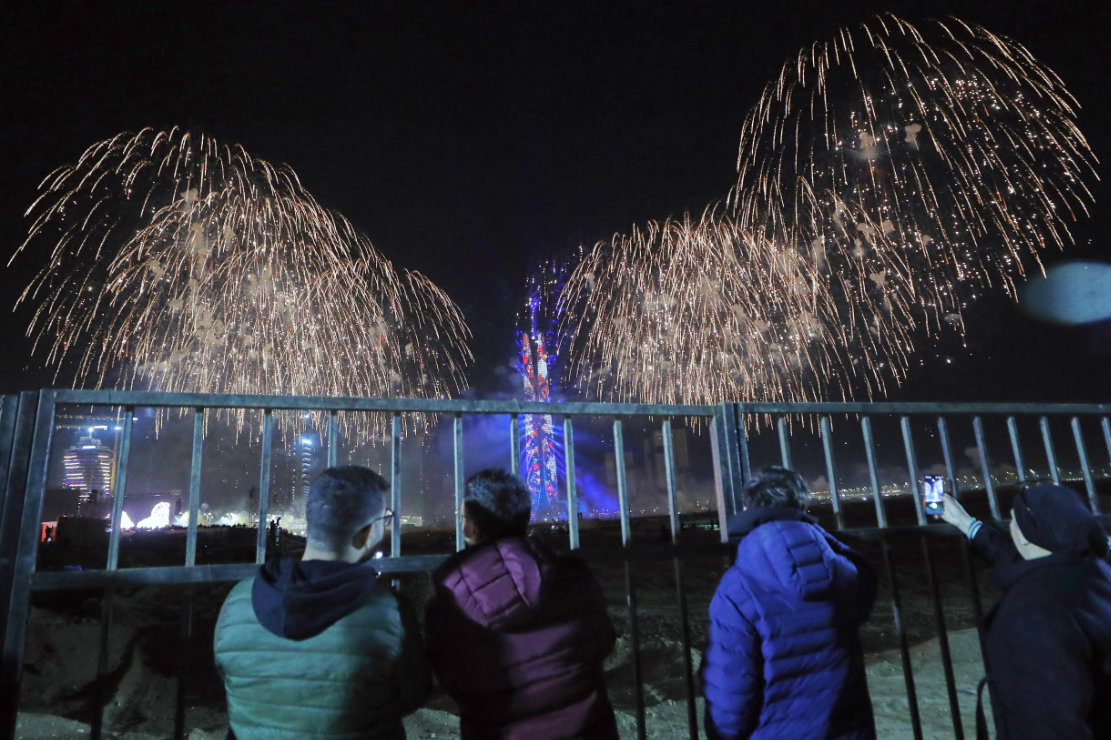
In several parts of the Arab world, especially the Gulf states, new year’s celebrations have taken on a distinctly public, friendly and communal character. Large cities appear to have emerged as global destinations for festivities, in which one can see the combination of modern urban spectacle and regional hospitality.
One can witness public gatherings, fireworks, cultural performances and family-oriented events, which also point to the expansion of public spaces for entertainment and social interaction. At the same time, some celebrations are more private.
New year festivities point to the region’s intriguing and remarkable cultural, religious and ethnic diversity.
Dr. Majid Rafizadeh
Although the new year is not an official religious or national observance in Saudi Arabia, the Kingdom has increasingly embraced the occasion as a cultural and social moment that welcomes both residents and international visitors in an inclusive and outward-looking spirit. In recent years, New Year’s Eve has been integrated into broader national entertainment frameworks — most notably through Riyadh Season — with festivities unfolding across multiple days and venues, combining large-scale public events with family-oriented attractions, international sports competitions, concerts and immersive cultural experiences.
In the capital, areas such as Boulevard City have become focal points for light shows, live performances, diverse culinary offerings and midnight fireworks, while coastal cities like Jeddah and Dammam host open, accessible celebrations along their corniches, blending music, public gatherings and waterfront displays.
In several cities across the region, new year celebrations now extend well beyond a single evening, unfolding over multiple days and transforming urban spaces into sites of prolonged cultural and social engagement. For example, rather than confining festivities to New Year’s Eve alone, Dubai came up with an extended program that stretches across more than a week. Central districts have become immersive public arenas, combining large-scale visual displays, performances and communal events. So, this event is not being viewed as a single moment but as a continuous, collective experience.
Beyond the Gulf, new year practices across North Africa and the Levant are often a mixture of global customs and local traditions and sensibilities. For example, in countries such as Egypt, Lebanon, Morocco and Tunisia, the new year is commonly observed through family gatherings, shared meals, music and sometimes quiet time spent together.
In some places, the occasion may appear less spectacular, but there are social events aimed at strengthening family ties, reconnecting with friends and expressing gratitude for patience through difficult times. This is particularly applicable in societies that have experienced political instability or economic hardship, with the new year becoming a symbol for collective survival and endurance.
Religious diversity across the region further enriches the meaning of the new year. MENA’s Christian communities tend to mark the occasion within a broader season of religious celebration and spiritual reflection. For these communities, the transition into a new calendar year carries emotional significance. This highlights the fact that their continued presence and participation in public and private celebrations shows the region’s long-standing pluralism and shared cultural heritage.
The Gregorian new year is seen as an additional moment of connection, reinforcing rather than undermining social cohesion.
Dr. Majid Rafizadeh
Furthermore, ethnic and cultural minorities — including Kurds in parts of the Levant — also engage with the new year. While some communities may prioritize their own traditional calendars and seasonal festivals, the Gregorian new year is seen as an additional moment of connection, reinforcing rather than undermining social cohesion in the region.
Importantly, this new year comes at a moment when there is a strong desire for peace, stability and dignity across the region. In other ways, the new year celebrations can be seen as a refusal to allow conflicts to define the entirety of the region’s social life, hospitality, friendship and cultural identity.
In summary, across the region, people of different religions, ethnicities, languages and historical traditions joined together to celebrate the new year, whether through public celebrations, family gatherings or quiet reflection. Even in societies where the Gregorian calendar is not formally recognized, the welcoming of visitors and accommodation of diverse forms of celebration reflect deeply rooted values of hospitality and inclusion.
This shared moment of transition should also point to the region’s unique characteristic of cohesion that transcends political boundaries and religious calendars; this comes from centuries of communal life, exchanges and cultural continuity.
New year celebrations are not just a modern social practice in the region but a reflection of its long-standing commitment to community, pluralism and peaceful coexistence. Across borders, religions and cultures, there is also a shared wish that 2026 brings an end to conflicts and cycles of violence, while ensuring greater respect for human life and dignity and lasting peace.
May 2026 be a year in which peace, forgiveness, prosperity, joy and friendship replace confrontation, conflict and division. And may the rich and extraordinary cultures of the Middle East and the Arab world continue to flourish in peace.
• Dr. Majid Rafizadeh is a Harvard-educated Iranian-American political scientist.
X: @Dr_Rafizadeh