
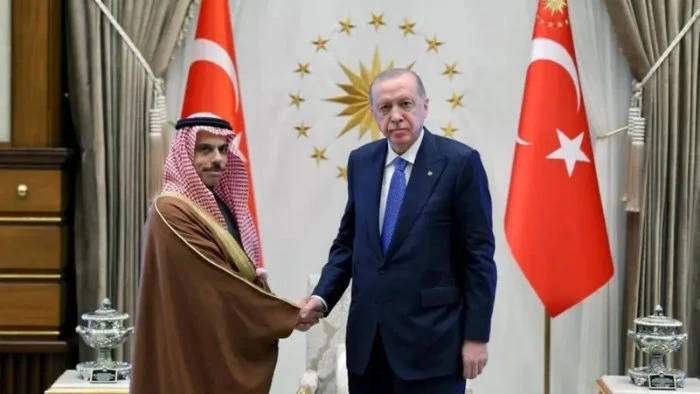

Saudi Foreign Minister Prince Faisal bin Farhan visited Ankara this week, where he met with Turkish President Recep Tayyip Erdogan and his Turkish counterpart, Hakan Fidan. Both foreign ministers co-chaired the third meeting of the Saudi-Turkish Coordination Council, which is the solid institutional mechanism created to strengthen ties between Riyadh and Ankara.
While high-profile visits and the signing of major agreements often make headlines in Saudi-Turkish relations, a gradual process of institutionalization in relations is taking shape. Therefore, it is important to highlight the mechanisms of this process, and to understand why institutionalization matters for the long-term goals in Saudi-Turkish relations.
Institutionalization in international relations refers to a structured cooperation that includes regular diplomatic coordination and creation of formal and issue-specific mechanisms. In the case of Saudi-Turkish relations, the Saudi-Turkish Coordination Council represents a solid example of institutionalization in relations. Created in 2016, the council aimed to be the main platform for structured cooperation. Although its effectiveness remained limited for several years, it gained momentum last year, when it convened its second meeting. Over the past two years, the council has transformed relations between Riyadh and Ankara into a more structured form of intergovernmental cooperation.
The significance of such mechanisms is often underestimated. However, the council is more than just a formal body. It facilitates closer cooperation across several domains in relations from trade to security. The Saudi-Turkish Parliamentary Friendship Committee is another mechanism that functions to strengthen ties between the Saudi Shura Council and the Turkish Grand National Assembly. In international relations, such mechanisms are often described as contributing to “institutional resilience,” meaning they provide continuity in bilateral relations even when the political atmosphere changes.
The shift toward institutionalization has become particularly visible in defense and security cooperation, with the signing of military cooperation agreements, the expansion of defense industry partnerships, and increased intelligence coordination, all of which reflect a more coordinated approach in Saudi-Turkish relations. In particular, defense cooperation has emerged as one of the strongest institutional pillars in their relations.
Institutionalization is also evident in the economic and infrastructural cooperation. To raise trade volume and institutionalize economic cooperation, Saudi-Turkish business forums have been organized to bring together stakeholders from both countries. Last year, the two sides also convened the Saudi-Turkish Economic Cooperation Summit, which provided a platform for businessmen and investors to explore new opportunities for collaboration and investment.
More recently, the Saudi-Turkiye Investment Forum was held in Riyadh in February for the same purpose. Speaking at the event, the Saudi investment minister said that the investment forum reflected an unprecedented level of political and economic alignment between the two countries and demonstrated the determination of both leaderships to expand their partnership to “new strategic horizons.”
Defense cooperation has emerged as one of the strongest institutional pillars in their relations.
Dr. Sinem Cengiz
After the agreement between Saudi Arabia Railways and Turkish State Railways, the two countries announced plans this month for a rail project that would link the Kingdom to Turkiye via Jordan and Syria, with completion expected by the end of the year. This initiative reflects close coordination in transport cooperation, as both Riyadh and Ankara seek to enhance regional connectivity and facilitate trade along a strategic north-south corridor.
During the third meeting of the Saudi-Turkish Coordination Council, the two sides also signed an agreement on mutual visa exemption for holders of diplomatic and special passports. This represents not only a further step in the institutionalization of ties, but also a clear expression of political will to deepen both political and economic relations.
Both Saudi Arabia and Turkiye — two middle powers — occupy significant positions within the international system, particularly in global energy and economic markets. Both are influential members of the Organization of Islamic Cooperation and the G20. At the same time, both maintain strong ties with Western political and security frameworks, while keeping pragmatic relations with Russia and China. Thus, both are positioned at the crossroads of key political and economic coalitions.
Saudi Arabia and Turkiye increasingly acknowledge that the regional order is undergoing significant transformation. Within this broader context, they are increasingly structuring their relations, and this is a reflection of the strategic alignment emerging between them. This alignment is being shaped by broader shifts in the region. The Gaza war, the collapse of the Syrian regime, the US-Israeli conflict with Iran, and the uncertain security situation that emerged due to these developments is collectively pushing Riyadh and Ankara toward an institutionalized form of relationship as a means of mitigating instability.
Saudi Arabia and Turkiye’s regional visions are increasingly converging. Both countries prefer centralized state structures in the region as the best way to achieve stability. For example, in Syria, since the fall of the Assad regime, the idea of a strong, centralized state has been reinforced by both Riyadh and Ankara. Their emphasis on centralization should be read as a broader political and economic trend. The post-Assad transformation in Syria has opened space for new regional connectivity initiatives. Both Saudi Arabia and Turkiye view a functioning central authority in Syria as essential not only for political stability, but also for advancing their long-term connectivity initiatives.
Therefore, the development of Syria’s transport infrastructure is seen as a key priority for enhancing both regional connectivity and security. Achieving these objectives requires sustained coordination, which further highlights the importance of institutional mechanisms. Within this context, both states may also consider establishing a High Strategic Committee, like the one Turkiye has with Qatar. Such institutionalized mechanisms matter because they create channels of communication that continue functioning even during times of disagreement.
Institutionalization functions not only as a mechanism for cooperation, but also as a tool for strategic risk management, helping to reduce the adverse impacts of shifting regional dynamics. A turn toward institutionalized relations is key for both Riyadh and Ankara to achieve their shared regional vision and build their cooperation on a sustainable basis.
• Dr. Sinem Cengiz is a Turkish political analyst who specializes in Turkiye’s relations with the Middle East.
X: @SinemCngz


