
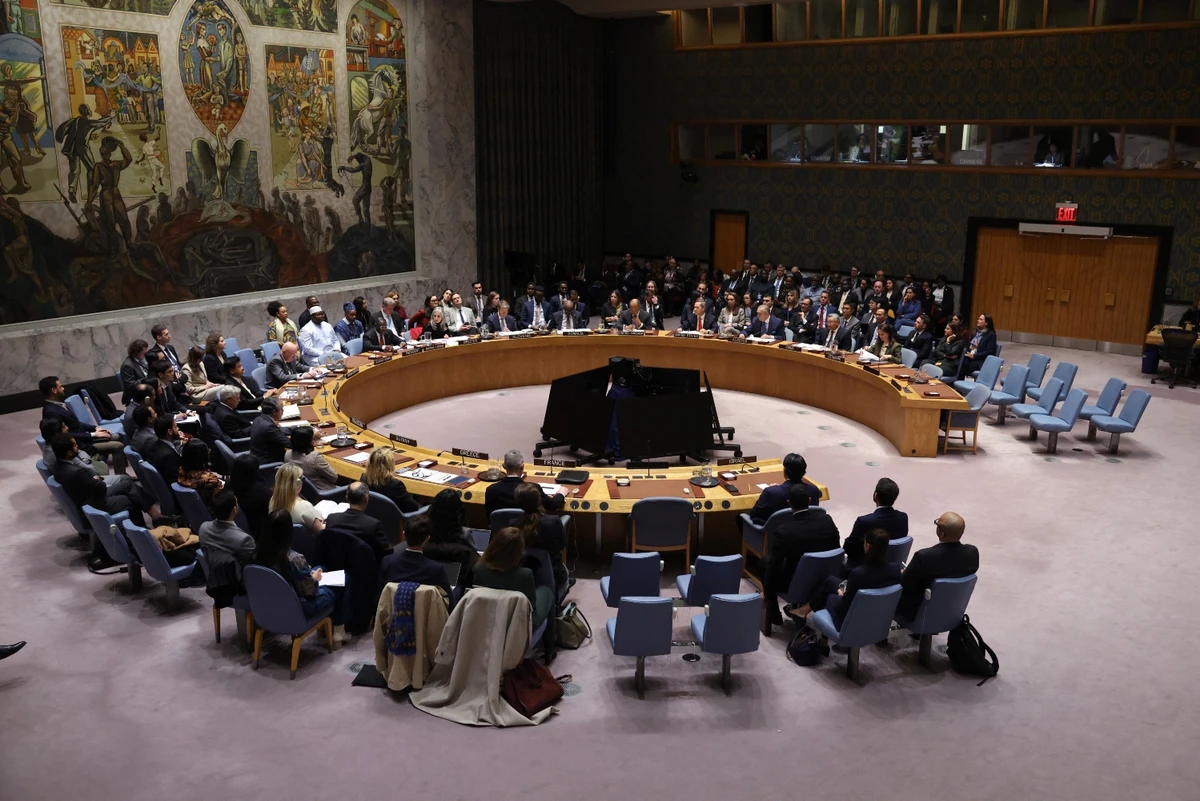

On Monday, the UN Security Council formally adopted US President Donald Trump’s 20-point plan for Gaza and the start of a possible “pathway to Palestinian self-determination and statehood.”
That the resolution passed without opposition or serious amendment is a measure of the global consensus on Gaza and Palestine. It also indicates that the US has decided to join that consensus. For a long time, Washington preferred to distance the UN from the Arab-Israeli conflict to shield Israel from censure by the world body. This time, the US led the effort to “internationalize” the conflict and add the UN’s support and legitimacy to its plan.
China and Russia joined that consensus, abstaining instead of voting against the resolution. They both had the power of veto to stop the resolution from being adopted, but they chose not to exercise it. Russia quickly abandoned its own draft resolution to allow the American version to pass. This is the right approach to restore the UN’s mandate over Gaza and the underlying Palestine conflict, even if you disagree with some of the details of the resolution.
The UNSC resolution is historic in that it has been some time since the council got into the details of this conflict so comprehensively. The last time was perhaps Resolution 2334 of December 2016, which called on Israel to “immediately and completely cease all settlement activity in the occupied Palestinian territory, including East Jerusalem,” and to “fully respect all of its legal obligations in this regard.” The difference is that allowing Resolution 2334 to pass was a parting shot by the Obama administration, which had only weeks to go before leaving office. This time, the Trump administration is leading the UN effort and it has more than three years in office to see its implementation through.
It has been some time since the UN Security Council got into the details of this conflict so comprehensively
Dr. Abdel Aziz Aluwaisheg
In Monday’s vote, the council endorsed the US’ “Comprehensive Plan to End the Gaza Conflict” and called on “all parties” to “to implement it in its entirety, including maintenance of the ceasefire, in good faith and without delay.” It also praised last month’s “Trump Declaration for Enduring Peace and Prosperity.”
What does this all mean in practical terms?
First, the UN is endorsing the Board of Peace as a transitional administration with international legal personality, which will likely be headed by Trump himself and will set the framework and coordinate funding for the redevelopment of Gaza, in a manner “consistent with relevant international legal principles,” according to the resolution.
Second, the mandate of the board will continue until the Palestinian Authority has “satisfactorily completed its reform program” and until it can “securely and effectively” take back control of Gaza. This measure puts the ball in the PA’s court to accelerate the reform process to enable it to govern Gaza.
Third, after the PA reform program is “faithfully carried out” and Gaza redevelopment has advanced, the conditions may finally be in place for a credible pathway to Palestinian self-determination and statehood. Although quite tepid, this clause marks an important turning point for the Trump administration, which in the past opposed such an approach and even worked behind the scenes to scuttle Saudi-French efforts to mobilize support for the implementation of the two-state solution.
Fourth, the full resumption of humanitarian aid into the Gaza Strip in a manner “consistent with relevant international legal principles and through cooperating organizations, including the United Nations, the International Committee of the Red Cross, and the Red Crescent.”
Fifth, the establishment of a “transitional governance administration” to support a “Palestinian technocratic, apolitical committee of competent Palestinians from the Strip,” as championed by the Arab League, which will be responsible for the day-to-day operations of Gaza’s civil service and administration.
Sixth, the reconstruction of Gaza, economic recovery programs and delivery of public services and humanitarian assistance in the Strip.
Seventh, the funding will be through voluntary contributions. The UNSC called on the World Bank and other financial institutions to “facilitate and provide financial resources to support the reconstruction and development of Gaza, including through the establishment of a dedicated trust fund for this purpose and governed by donors.”
Finally, in the most controversial part of the plan, the council authorizes the establishment of a temporary International Stabilization Force in Gaza to deploy under unified command acceptable to the Board of Peace, with forces contributed by participating states, “in close consultation and cooperation” with Egypt and Israel, along with the newly trained and vetted Palestinian police force.
Israel’s role in this plan is the most difficult to predict and could delay or prevent its implementation
Dr. Abdel Aziz Aluwaisheg
The new force will operate “under the strategic guidance” of the Board of Peace and will be funded through voluntary contributions from states. Its tasks are many: monitor the implementation of the ceasefire in Gaza; help secure border areas; demilitarize the Strip; destroy military, terror and offensive infrastructure; decommission weapons from nonstate armed groups; protect civilians, including humanitarian operations; secure humanitarian corridors; and train and provide support to the vetted Palestinian police forces.
Israel’s role in this plan is the most difficult to predict and could delay or prevent its implementation. Tel Aviv may interpret the “consultation and cooperation” process as veto power. However, the resolution goes on to say that the force would exercise its authority “consistent with international law, including international humanitarian law,” which would mean that the board can intervene to press Israel on such likely hiccups.
As the new force establishes control and stability, Israel is required to withdraw its forces from the Gaza Strip based on timeframes linked to demilitarization. This is where another potential obstacle arises. The terms of the withdrawal will have to be negotiated between Israel and the guarantor states, including the US.
The third security obstacle that will need to be sorted out with Israel is that the plan allows for a “security perimeter presence” that will remain until “Gaza is properly secure from any resurgent terror threat.” This provision could be interpreted by Israel in such a way as to maintain its security presence for a long time.
The mandate of the Board of Peace and international civil and security presences authorized by this resolution is for about two years, until Dec. 31, 2027, but could be renewed if necessary.
While it enjoys global support, hard-liners in Israel and Iran have predictably opposed the UN plan. Extremists in Benjamin Netanyahu’s government have denounced it, calling for perpetual war. Iran’s Foreign Ministry has also criticized it, while groups allied with Tehran have openly condemned it. Hamas has sent mixed messages, mostly negative, but the PA has given its endorsement.
Despite the loopholes, this resolution marks a breakthrough for peace in Gaza and a victory for the Trump administration. It opens a small window for a political solution to the wider conflict. A lot of hard work remains, but the fact that Trump is personally invested in this effort and that the world is also fully committed means it has a good chance of success.
- Dr. Abdel Aziz Aluwaisheg is the GCC assistant secretary-general for political affairs and negotiation. The views expressed here are personal and do not necessarily represent those of the GCC. X: @abuhamad1


