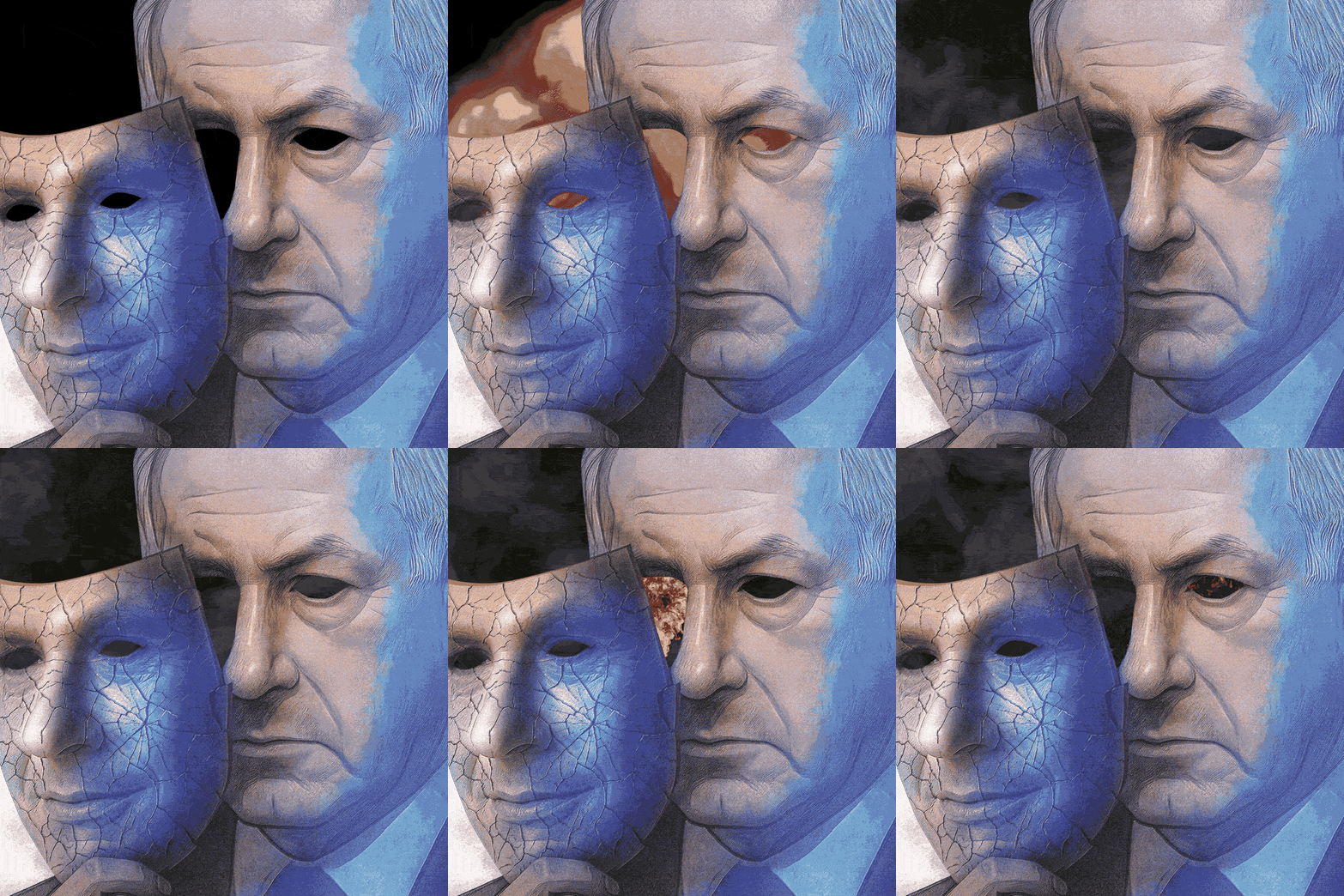

The year 2025 has, in many respects, been a positive one for Israel and its embattled leader, Benjamin Netanyahu, who has been fighting on multiple internal and external fronts. The year that ushered in the second term of a decidedly pro-Israel US president, Donald Trump, also saw the release of Israeli hostages and the continued military dominance of Israel over its Arab neighbors.
Yet despite these visible successes, Netanyahu has been unable to shake off his deep domestic troubles, nor has Israel managed to repair its fractured international image. Recognition of the state of Palestine has reached an all-time high, with 157 of the UN’s 193 member states now acknowledging it. Four of the five permanent members of the UN Security Council, along with most Western countries and the Holy See, are among those that now recognize Palestine.
Following his inauguration, Trump appeared extremely supportive of the Israeli leader. The US imposed sanctions on the International Criminal Court and on the UN rapporteur for Palestinian human rights. In an extraordinary move, Trump and his secretary of state also blocked the Palestinian delegation — including the moderate President Mahmoud Abbas — from entering America to attend September’s UN General Assembly in New York.
The US administration continued its efforts to delegitimize UNRWA and maintained unrestrained military, financial and political backing for Israel. During a visit to Israel, Trump addressed the Knesset and made an unprecedented intervention in the country’s domestic affairs by urging the Israeli president to pardon his close friend, Netanyahu, who faces four corruption and abuse of power trials. Trump even briefly embraced Israel’s dreams of ethnically reshaping Gaza, expressing support for turning it into a “Gaza Riviera” emptied of its population and publicly backing the deportation of Gazans to third countries.
The anxiety among Israelis stems in part from the dramatic collapse of the country’s once-dominant global image
Daoud Kuttab
These positive signals from Washington appear to have boosted Israelis’ sense of well-being, which a Gallup poll found had “returned to a level last seen before the Israel-Hamas war started nearly two years ago, even as the war remains the most important problem on their minds.” Israelis surveyed in July and August rated their lives at 7.5 out of 10 — nearly a full point higher than the 6.8 recorded in late 2023, shortly after the Oct. 7 attacks. According to Gallup, the drop in life evaluations between 2022 and 2023 had been the steepest year-to-year decline the organization had recorded for any country during that period.
Yet, even though daily stress and sadness among Israelis have eased since the start of the war on Gaza, the Palestinian-Israeli conflict continues to dominate public consciousness. When asked in an open-ended question by Gallup to identify the most important problem facing their country, 71 percent of Israelis cited issues related to law and order — war, conflict and violence. Fewer than one in 10 pointed to economic problems (9 percent) or government performance (6 percent).
The anxiety among Israelis stems in part from the dramatic collapse of the country’s once-dominant global image. Israelis traveling abroad are experiencing firsthand the shift in global opinion. The popular Eurovision Song Contest — in which Israel, despite being a non-European country, has long competed — faces boycotts from several leading countries, including Ireland, Spain, the Netherlands and Slovenia.
While efforts to expel Israel from international athletic contests (as happened to Russia) have so far failed, Israeli sports teams have been met with anger and mass demonstrations during international competitions. Israeli fans were barred from attending one of their own team’s matches in the UK and crowds at other games have loudly expressed solidarity with Palestinians and anger toward Israel.
For Netanyahu, the early closeness with Trump proved short-lived. The American leader continued to push — successfully — for the release of Israeli hostages, but his 20-point plan, first presented to Arab and Muslim leaders in New York in September, reversed earlier ideas about a depopulated Gaza and the ethnic cleansing fantasies that Netanyahu had.
However, Trump’s plan — unveiled at a high-profile ceremony in Sharm El-Sheikh, notably without Netanyahu or any Israeli officials present — has stalled at its very first phase. While the hostages were released, the promised ceasefire never materialized. More than 350 Palestinians have been killed since the plan’s Oct. 10 debut. Food supplies continue to trickle into Gaza at far below the promised rate of 600 trucks per day.
Neither the proposed Palestinian technocratic committee nor the International Stabilization Force have been established, let alone deployed to govern Gaza or enforce a ceasefire. Israel vetoed the participation of Turkiye and Qatar, while Jordan and the UAE have refused to send troops. Even Uzbekistan — reportedly favored by Israel — declined to contribute forces.
It remains unclear whether Netanyahu will be spared conviction, imprisonment or political disqualification
Daoud Kuttab
The Rafah crossing also remains effectively closed. Israel has permitted Gazans to leave the enclave but has resisted the two-way movement envisioned in the American plan.
And despite Trump’s personal advocacy, it remains unclear whether Netanyahu will be spared conviction, imprisonment or political disqualification. Citing Trump’s public call for clemency, Netanyahu submitted an unusual pardon request that failed to include the legally required elements: an admission of guilt, an expression of remorse or a commitment to step away from political life. Although Israel’s president has broad and largely unchecked pardoning powers, it is unlikely he will grant Netanyahu a clean pardon without imposing some restrictions. Elections are expected in 2026 and the polls show no realistic scenario in which Netanyahu can assemble another majority coalition.
Some of the regional gains Netanyahu’s government has claimed are also proving temporary. Israel’s routine military operations in Syria and Lebanon have drawn harsh criticism, even from the Trump administration, which hosted Syrian leader Ahmad Al-Sharaa at the White House. Israel has also faced public rebuke from the new Pope Leo XIV, who visited Lebanon and spoke openly about the humanitarian catastrophe in Gaza.
Israel’s vaunted aerial supremacy is facing new challenges, as the Trump administration has agreed to sell advanced F-35 jets to Saudi Arabia. Egypt has also reasserted its regional influence. Since the Sharm El-Sheikh event, Cairo has emerged as a key player, alongside Turkiye, in efforts to resolve the Gaza crisis.
Even Israel’s once-unshakable base of American Christian fundamentalist support appears to be weakening. The Netanyahu government has invested millions in attempts to rebuild its image among Christian Zionists, a constituency that many believed Israel could never lose. Yet cracks are appearing, including within the Republican Party. Even members of Congress and new candidates for public office have begun publicly rejecting American Israel Public Affairs Committee funding.
On the surface, 2025 has been a banner year for Israel and for Netanyahu. But this honeymoon seems to be ending. The year 2026 looms, with several political and diplomatic landmines that even Netanyahu — long celebrated for his political survival skills — may not be able to avoid. Across much of the world, the perception of Israel as a peaceful, liberal democracy resisting barbarism has eroded. New generations of activists are using social media to challenge decades of pro-Israel narratives.
Ultimately, the fate of Israel’s longest-serving prime minister now lies in the hands of the Israeli president — and, soon after, with Israeli voters in the upcoming Knesset elections. Whether Netanyahu can once again find a way to cling to power remains uncertain.
- Daoud Kuttab is an award-winning Palestinian journalist and former Ferris Professor of Journalism at Princeton University. He is the author of “State of Palestine Now: Practical and Logical Arguments for the Best Way to Bring Peace to the Middle East.” X: @daoudkuttab